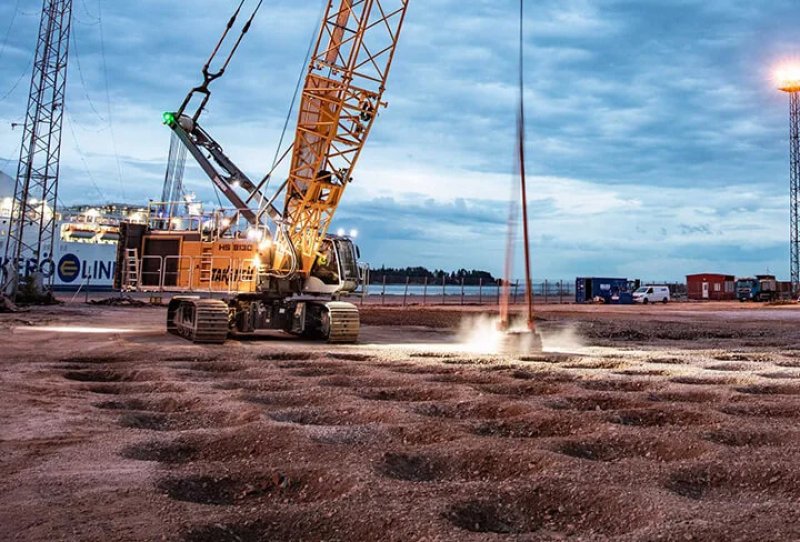
Soil Improvement Works
Every construction project must be founded on safe and solid ground. However, nature does not always provide suitable soils for engineering needs. In heavy-load structures such as underground structures, high-rise buildings, bridges, highways, dams, or industrial facilities, the ground often cannot be used directly. This is where soil improvement work comes into play: a set of techniques applied to improve the existing soil properties to meet engineering requirements.
Rhino Engineering, with its knowledge, field experience, and modern equipment, undertakes safe projects throughout Turkey.
What is soil improvement?
Soil improvement is a process designed to increase the bearing capacity of natural soil, reduce settlement problems, eliminate the risk of liquefaction, and ensure water resistance. These processes can be used in both new projects and existing structures.
The Importance of Soil Improvement
Bearing capacity is increased: The structure is enabled to carry loads safely.
Settlement problems are reduced: By preventing uneven settlement, structural stability is maintained.
Earthquake safety is ensured: The risk of liquefaction is eliminated.
Groundwater control is performed: Water pressure and leaks are prevented.
Provides economic benefits: Foundation costs are reduced, reducing the need for additional excavations or piling.
Turkey's location in an earthquake zone makes ground improvement work crucial.
Ground improvement methods applied by Rhino Engineering
1. Jet Grout
Soil columns are created through high-pressure cement injection.
The soil hardens, increasing its bearing capacity.
Frequently used in subway, tunnel, and deep foundation projects.
2. Injection Methods
Cement or chemical materials are pressed into the ground to fill the voids.
Both impermeability and strength are achieved.
3. Stone Column
Columns of stone material are placed in the ground.
The risk of settlement is reduced in compressible soils.
4. Vibro Compaction
Compactment is achieved by vibrating loose, sandy soils.
The risk of liquefaction is reduced.
5. Deep Soil Mixing
Cement-based mixtures are mixed into the soil to form columns.
It is especially used in soft clay soils.
6. Drainage Systems
Excess water is removed.
Soil drainage increases bearing capacity.
Application Areas of Soil Improvement Work
Rhino Engineering offers soil improvement solutions in various sectors:
Building foundations: High-rise buildings, residences, and shopping mall projects.
Transportation structures: Highway, railway, bridge, and viaduct foundations.
Dams and reservoirs: Sealing and body safety.
Industrial facilities: Soils carrying heavy machinery loads.
Metro and tunnels: Preventing settlement and water pressure during excavation.
Rhino Engineering's soil improvement process
Soil investigation and geotechnical analysis: Field drilling and laboratory tests are performed.
Method selection: The most appropriate technique is determined based on the soil type and project needs.
Application: Improvement is carried out using modern machinery and expert teams.
Inspection and testing: Soil bearing capacity and strength are measured.
Reporting: The work is documented according to national and international standards.
The Need for Soil Improvement in Turkey
Due to Turkey's geological structure, soft, compressible, and water-saturated soils are found in many regions. Therefore, soil improvement techniques are indispensable for large-scale projects.
Examples:
In areas at risk of liquefaction along the coastal areas of Istanbul,
In high-rise buildings in loose soils in Izmir and Adana,
In dam projects in Southeastern Anatolia,
In transportation projects along the Black Sea coast,
Soil improvement work is vital.
Rhino Engineering's Difference
Extensive equipment pool (jet grouting machines, vibro-compaction equipment, injection pumps),
Expert geological and civil engineers,
Fast and reliable field applications,
Environmentally sensitive and economical solutions,
Reporting in accordance with domestic and international standards.
Conclusion
Soil improvement works are one of the most critical stages of modern civil engineering. Rhino Engineering, with its experience and technology, contributes to the successful completion of projects by making weak soils safe.
In short, Rhino Engineering's ground improvement services are the most effective way to build safe, durable, and sustainable structures in Turkey's challenging ground conditions.