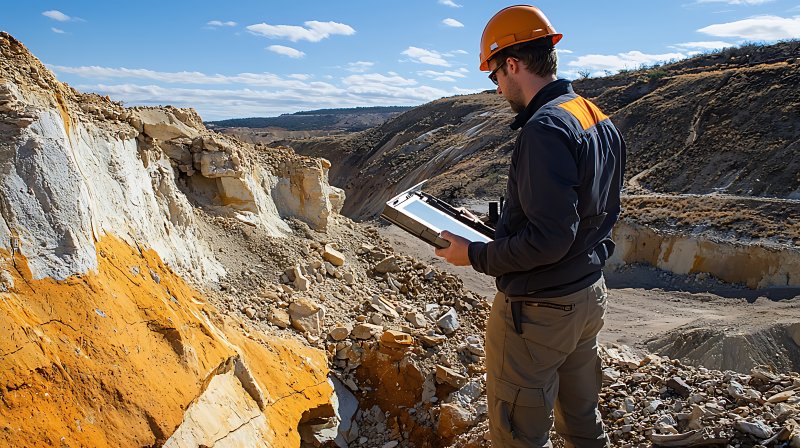
Geotechnical Investigations
One of the most crucial stages of civil engineering is determining the soil and its engineering properties for the structure to be built. The primary goal of all studies related to soil and rock mechanics is to ensure the safe, durable, and economical implementation of the project. Geotechnical investigations are a critical stage in determining the fate of a project. With its expert engineering team and advanced technological infrastructure, Rhino Engineering stands out as one of the most reliable companies in the geotechnical investigations sector.
The Importance of Geotechnical Investigations
The durability of a structure is directly related not only to the quality of the materials used or the engineering design, but also to the properties of the ground on which it sits. If the soil lacks sufficient bearing capacity or presents risks such as settlement, liquefaction, or landslides, even the most robust designs can fail. Therefore, detailed geotechnical investigations are crucial before construction.
For example:
Buildings constructed without adequate soil investigations can collapse during an earthquake.
Buildings constructed in areas prone to liquefaction can suffer serious damage even from minor tremors.
Roads and buildings constructed in landslide-prone areas can quickly become unusable.
To prevent such disasters, geotechnical investigations must be conducted accurately and completely.
Rhino Engineering's Approach to Geotechnical Investigations
Rhino Engineering does not view geotechnical studies solely as a process of determining soil properties. The company approaches each project within a comprehensive engineering discipline. The goal is not only to define the soil but also to create the safest and most economical construction conditions.
The company follows the following steps in this process:
Preliminary investigation: Existing information about the site is collected and past reports are reviewed.
Field studies: Drilling, sampling, standard penetration tests (SPT), and CPTu tests are conducted.
Laboratory tests: Grain analysis, Atterberg limits, shear box tests, and consolidation tests are performed on soil samples.
Data analysis: All obtained data is converted into engineering calculations.
Reporting: Bearing capacity, settlement estimates, liquefaction risk, and soil classifications are reported.
Methods Used in Geotechnical Investigations
Rhino Engineering determines soil properties using the most up-to-date methods. Some of these include:
Drilling operations: Rotary drilling, core drilling, and percussion drilling.
SPT (Standard Penetration Test): Measurement of soil resistance.
CPTu (Cone Penetration Test): Determination of soil layer properties.
Presiometer and dilatometer tests: Measurement of soil deformation properties.
Plate load tests: Determination of soil bearing capacity.
In-situ density and water content measurements.
Laboratory Tests
Samples collected from the field are subjected to detailed laboratory tests. The main tests performed in Rhino Engineering's laboratory include:
Grain analysis (grain analysis),
Atterberg limits,
Natural water content,
Shear box test,
Triaxial pressure test,
Consolidation test,
Permeability tests.
These tests clearly demonstrate the engineering parameters of the soil.
Application Areas of Geotechnical Investigations
Geotechnical investigations have become essential in many different fields. The services offered by Rhino Engineering include the following:
Residential projects: For the safety of building foundations.
High-rise buildings: Specialized soil analyses for large structures such as skyscrapers, towers, and stadiums.
Bridge and viaduct projects: Bearing capacity analyses for deep foundation systems.
Dams and reservoirs: For backfill materials and impermeability.
Highway and railway construction: Soil bearing capacity along the route.
Industrial facilities: Soil strength for heavy loads.
The Importance of Geotechnical Investigations in Turkey
Turkey is a country with a high concentration of active fault lines. Therefore, soil liquefaction, landslides, and settlements are frequently encountered problems. The 1999 Marmara Earthquake, in particular, painfully demonstrated the potential consequences of improperly conducted soil investigations. Rhino Engineering aims to minimize these risks through geotechnical investigations.
Rhino Engineering's Geotechnical Reports
Geotechnical reports are written in a language understandable not only to engineers but also to investors and public institutions. The reports include:
Soil profile,
Bearing capacity values,
Settlement estimates,
Liquefaction analysis,
Foundation recommendations,
Soil improvement methods.
Soil improvement recommendations in geotechnical investigations
Often, the natural soil may not have sufficient properties for construction. In these cases, Rhino Engineering recommends the following improvement methods:
Jet grouting,
Bored piling,
Soil injection,
Stone columns,
Drainage systems.
These solutions ensure safe construction conditions.
Rhino Engineering's Difference
Experienced engineering staff,
Modern drilling machines and laboratory equipment,
National and international standards